Deep-set Hand Pump Tubewell
Reliable groundwater access in low water table conditions
AIDE Private Limited designs and installs Deep-set Hand Pump Tubewells to ensure consistent access to groundwater in areas where the water table lies beyond the suction limit of conventional pumps. Engineered for performance and durability, this system enables safe water extraction from deeper aquifers using a force-mode pumping mechanism.
Product Overview & Mechanism
In many regions, declining groundwater levels make conventional shallow tubewells ineffective, as they cannot lift water beyond the suction limit (~7.5 meters). This leads to water scarcity and unreliable supply. The Deep-set Hand Pump Tubewell addresses this challenge by using a force-mode pumping system.
1Below Water Table Pumping
- Reliable water extraction from deeper aquifers
- Reduced risk of dry pumping
- Long-term usability in low groundwater zones
2Key Mechanism
- Operates in force mode, not suction
- Effective beyond 7.5 m depth limitation
- Ensures continuous water lifting from deep aquifers
Submerged Piston Mechanism
Groundwater enters through well screen/strainer
Water fills the casing pipe
Piston assembly below water table moves vertically
Manual pumping (handle movement) drives piston
Water is lifted upward during both strokes
Technical Drawings & Specifications
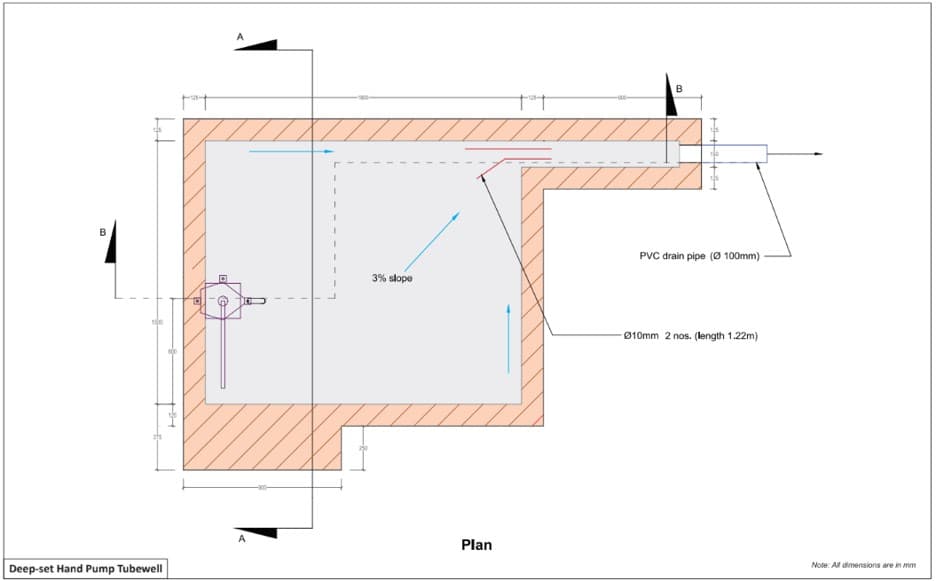
Plan View
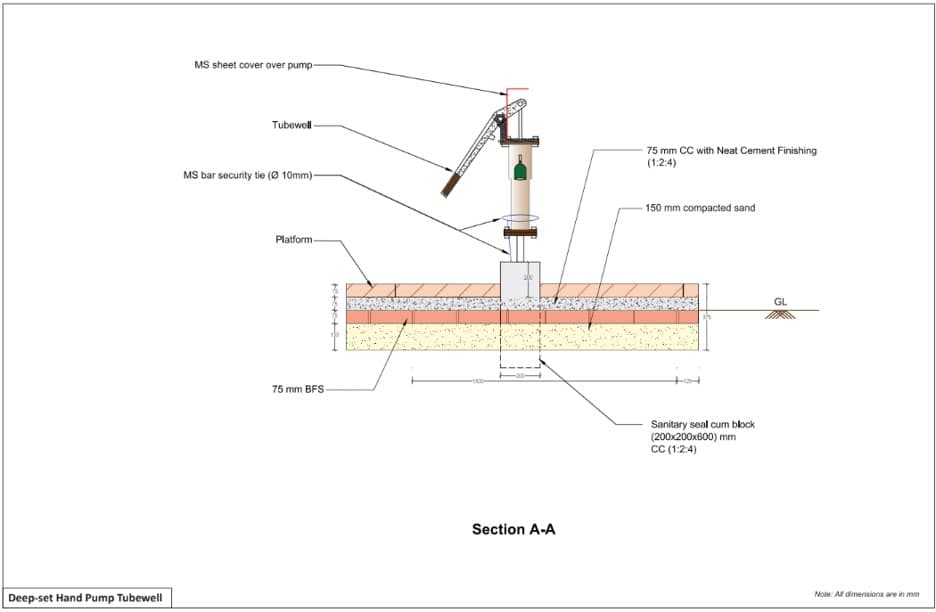
Section A-A
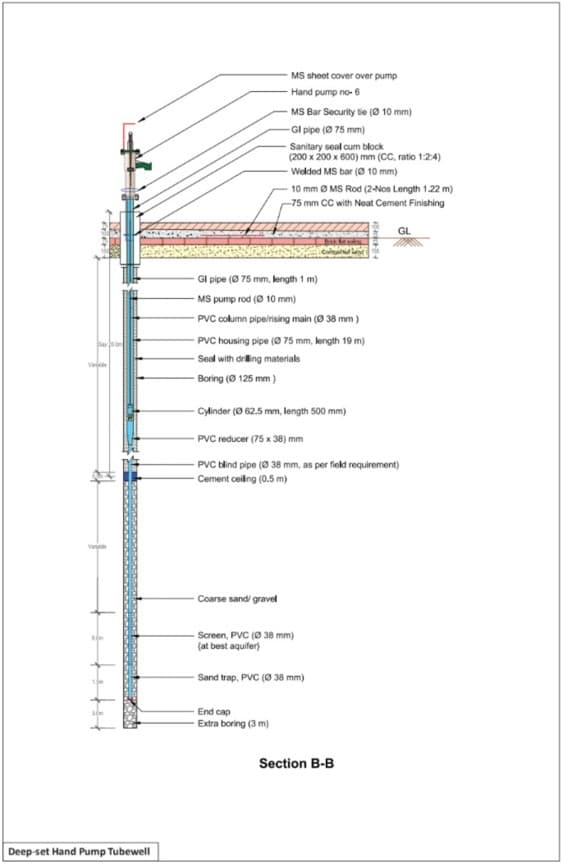
Section B-B
Detailed deep-set structure profile
Specifications
Proper design based on hydrogeological conditions and required depth.
Key Features
- Suitable for deep groundwater extraction
- Force-mode pumping mechanism (high efficiency)
- Durable casing and pipe system
- Continuous water lifting during both strokes
- Reduced risk of pump failure due to dry conditions
- Adaptable to varying hydrogeological conditions
Environmental & Public Health
- Ensures water access in drought-prone areas
- Reduces dependency on unsafe water sources
- Promotes sustainable groundwater use
- Supports climate adaptation in water-scarce regions
- Improves community resilience and health outcomes
Ideal Applications
- Low groundwater table areasWhere shallow pumps fail
- Drought-prone regionsAreas facing seasonal water scarcity
- Rural communitiesDependent on groundwater sources
- Water-stressed environmentsAreas with declining aquifers
- Development programsSustainable WASH water supply solutions
Implementation & Delivery
AIDE Responsibilities
- • Hydrogeological assessment and depth determination
- • System design and technical specification
- • Installation supervision and quality control
Construction & Installation
- • Skilled drilling and installation teams
- • Proper placement of piston assembly below water table
- • Secure casing and pipe connections
Community Integration
- • Formation of local management committee
- • Training of caretakers (minimum 3, including female representation)
- • Provision of maintenance tools and manuals
Operation & Risk Management
Routine Maintenance
- • Regular inspection of pump rod and piston movement
- • Checking casing pipe integrity
- • Cleaning surrounding platform and drainage
Water Safety Management
- • Periodic water quality testing
- • Monitoring for contamination risks
Rehabilitation & Disinfection
- • Purging may not fully remove pathogens
- • Shock chlorination recommended (~200 mg/L chlorine)
- • Retention period followed by flushing before reuse
Community-Based Management
Minimum 3 trained caretakers (including women) with access to maintenance tools and manuals. Local ownership ensures sustainability.
Why Partner with AIDE?
AIDE delivers technically sound and context-specific water solutions with strong expertise in hydrogeology and groundwater systems. We integrate water safety planning (CR-WSP) and offer end-to-end service from assessment to delivery, focusing on sustainability and community usability.