Desalination System (Reverse Osmosis - RO Plant)
Advanced membrane-based desalination for saline groundwater and surface water sources
AIDE Private Limited delivers Reverse Osmosis (RO) Desalination Systems designed to convert brackish and highly saline water into safe, potable water. Engineered for climate-vulnerable coastal regions, off-grid communities, and institutional facilities, these systems provide reliable high-purity water treatment where conventional methods fail.
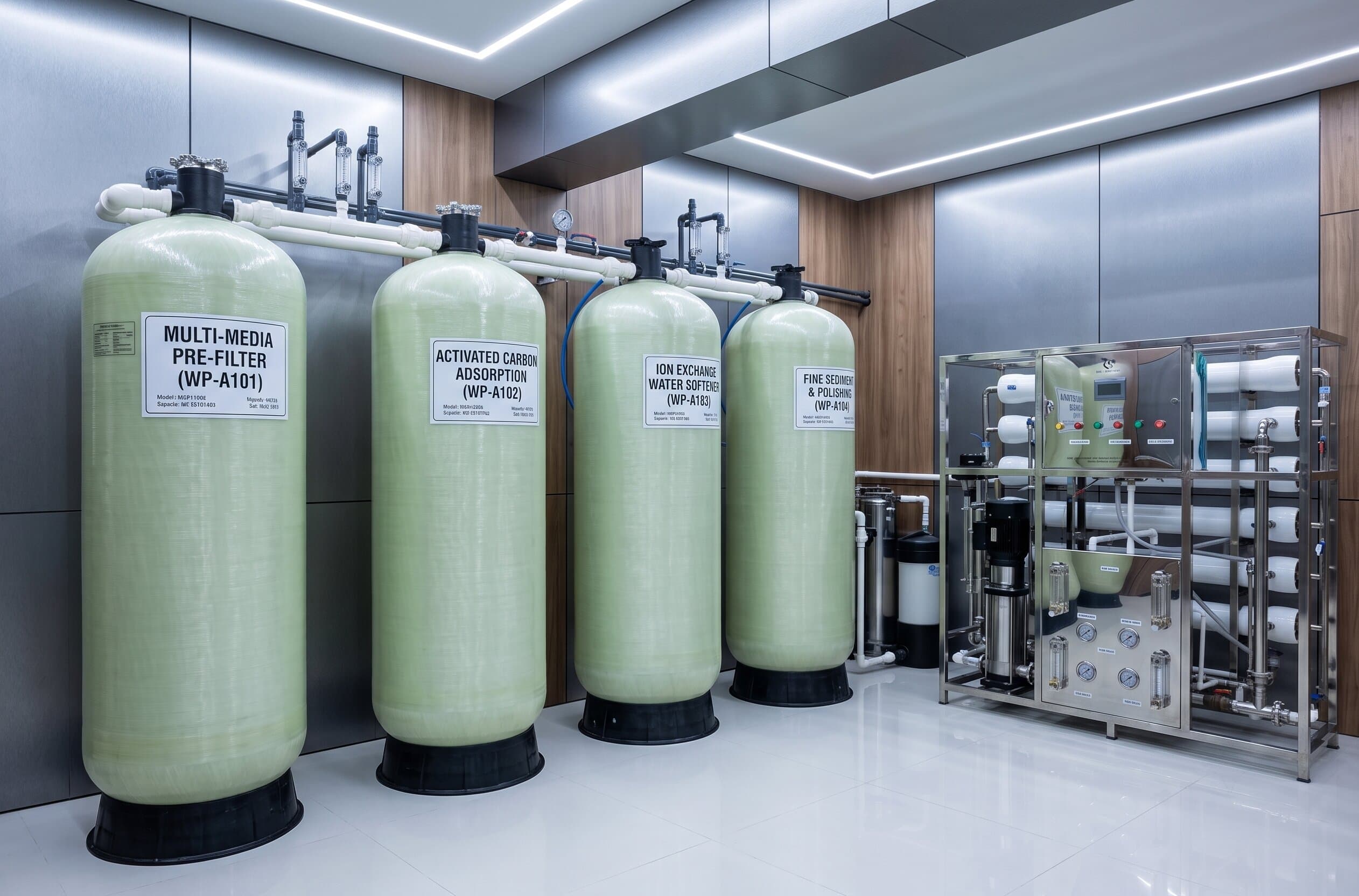
Product Overview & Configurations
Reverse Osmosis desalination forces saline water through semi-permeable membranes under high pressure, effectively removing dissolved salts, heavy metals, micro-pollutants, and pathogens. AIDE offers tailored configurations for different salinity levels and energy availabilities.
1Brackish Water RO (BWRO) System
Designed for coastal groundwater aquifers and inland surface water with moderate salinity levels (TDS 1,500 – 10,000 mg/L). Offers low operational power requirements and high water recovery rates.
- Ideal for community water kiosks & institutions
- Integrated multi-stage pre-filtration
- Low specific energy consumption
2Solar-Powered / Off-Grid RO System
Equipped with solar photovoltaic arrays and variable speed drive pumps, enabling continuous desalination in off-grid coastal villages without reliance on grid electricity.
- Sustainable zero-emission operations
- Automated controls & conductivity monitoring
- Resilient against coastal power disruptions
Multi-Stage Treatment Process
Raw water drawn into raw water storage tank
Pressurized through Multi-Media & Activated Carbon Filters
Passed through Micron Cartridge Filters (MCF)
High-pressure RO membrane separation removes dissolved salts
Post-remineralized & safe water delivered to clean reservoir
Technical Drawings & Specifications
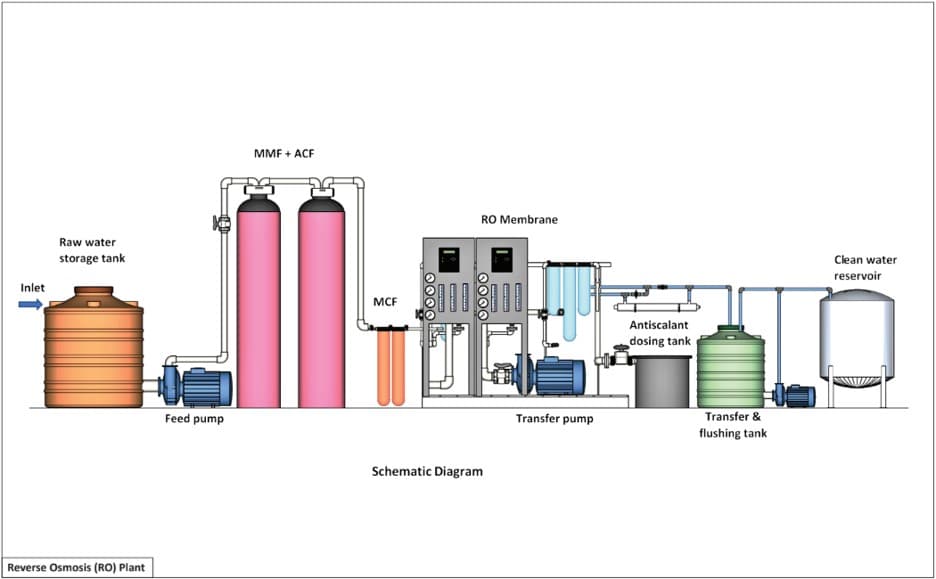
Process Schematic Diagram
Complete multi-stage water treatment, pressure filtration, and RO membrane flow
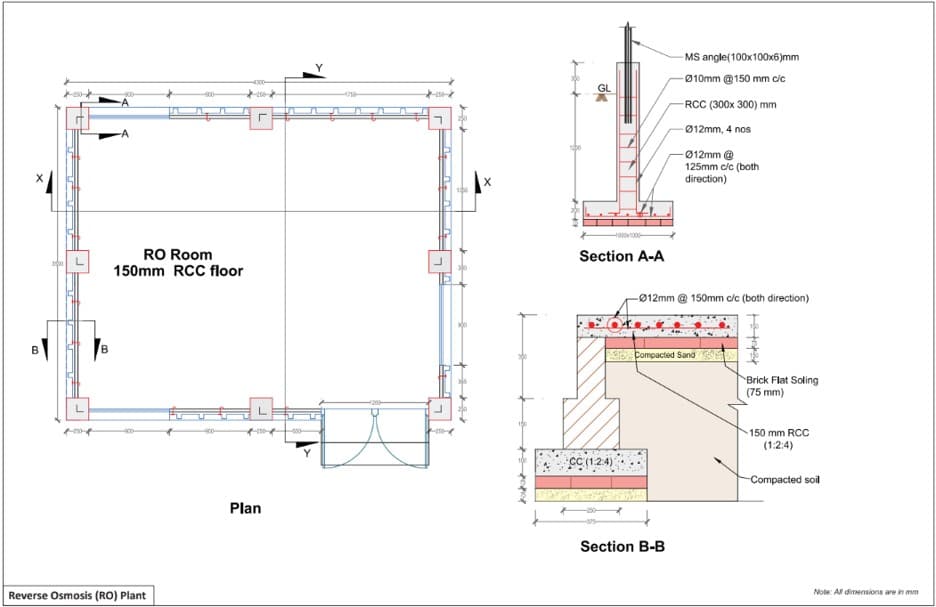
RO Room Plan & Section A-A / B-B
Structural layout and RCC foundation details
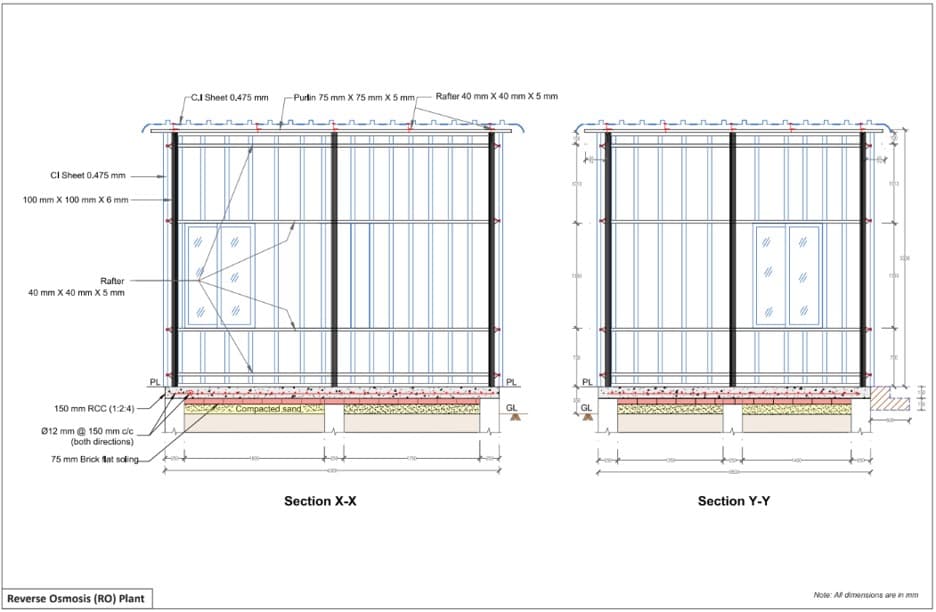
Sectional Elevation Views X-X & Y-Y
Structural cross-sections showing CI sheet roofing, rafters, purlins, and wall framing
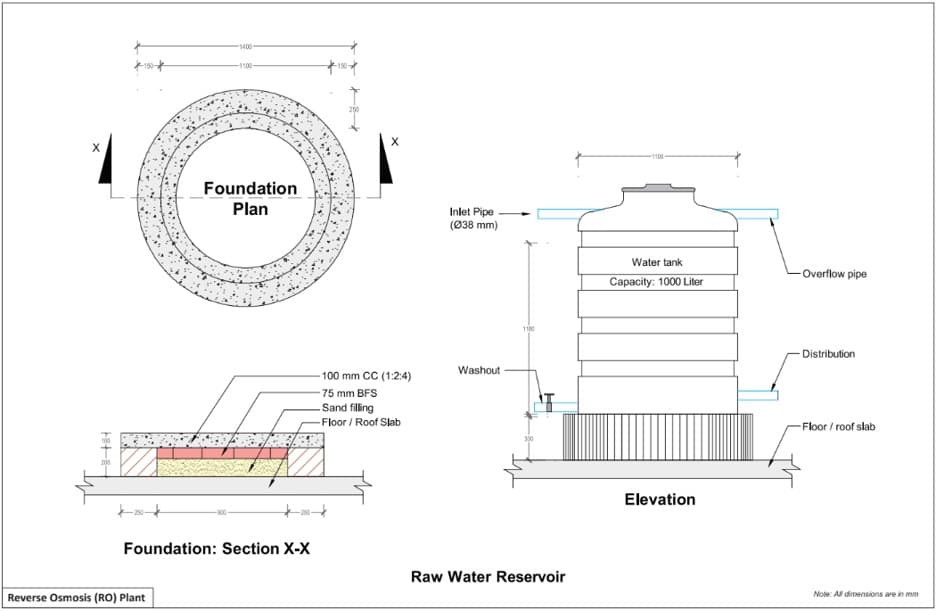
Raw Water Reservoir Foundation
1000L raw water tank elevation and foundation section X-X
Specifications
Engineered for reliable performance across saline conditions.
* BW = Brackish Water System, SW = Seawater Desalination System
Key Features
- High salt rejection rate (>99.2%) for sweet drinking water
- Integrated Clean-In-Place (CIP) membrane chemical flushing
- Automated online conductivity and TDS monitoring
- Low energy consumption with energy recovery devices
- Solar-PV hybrid compatibility for off-grid coastal regions
Impact & Public Health
- Mitigates hypertension and pre-eclampsia caused by saline water
- Ensures reliable safe water production in saline belts
- Replaces contaminated pond water with WHO-compliant freshwater
- Enhances climate adaptation against storm surges & sea level rise
- Protects public health by eliminating dissolved heavy metals & microbes
Ideal Applications
- Coastal saline districtsKhulna, Satkhira, Bagerhat, Cox's Bazar
- Off-grid island communitiesChar lands & remote coastal villages
- Decentralized water kiosksCommunity-managed drinking water hubs
- Disaster cyclone sheltersEmergency freshwater access post-disaster
- Hospitals & institutionsHigh-purity essential water supply
Implementation & Delivery
Engineered Delivery
System design begins with hydrogeological sampling and water analysis. RO skids and treatment units are pre-assembled off-site into modular frames or containerized housing, allowing rapid field deployment and strict quality control.
Joint Venture Model
Projects are implemented directly or through Joint Venture (JV) partnerships. AIDE leads system design, membrane selection, automation, and QA/QC, while partners support civil construction and local community engagement.
Operation & Maintenance
Maintenance Requirements
- • Daily checking of operating pressure, flow rates, and permeate TDS
- • Routine replacement of 5-micron pre-filter cartridges
- • Periodic Clean-In-Place (CIP) membrane chemical cleaning
- • Anti-scalant dosing tank replenishment
- • Routine water quality sampling and lab testing
Operational Notes
- • Automated pressure switches prevent dry-run pump damage
- • Membrane preservation procedures applied during prolonged shutdowns
Training
Local operators and water user committees are trained on daily operation, CIP procedures, logbook recording, and basic maintenance.
Why Partner with AIDE?
AIDE combines advanced membrane filtration expertise with practical deployment experience in climate-vulnerable coastal Bangladesh. With a focus on engineering quality, energy efficiency, and community sustainability, we ensure RO systems deliver clean water where salinity threatens public health.