Pond Sand Filter (PSF)
Transforming pond water into safe, reliable drinking water
AIDE Private Limited designs and implements Pond Sand Filter (PSF) systems that convert pond water into safe and usable drinking water through controlled filtration and disinfection. Available in both standard and solar-powered configurations, PSFs are highly effective in coastal, arsenic-affected, and water-scarce regions.
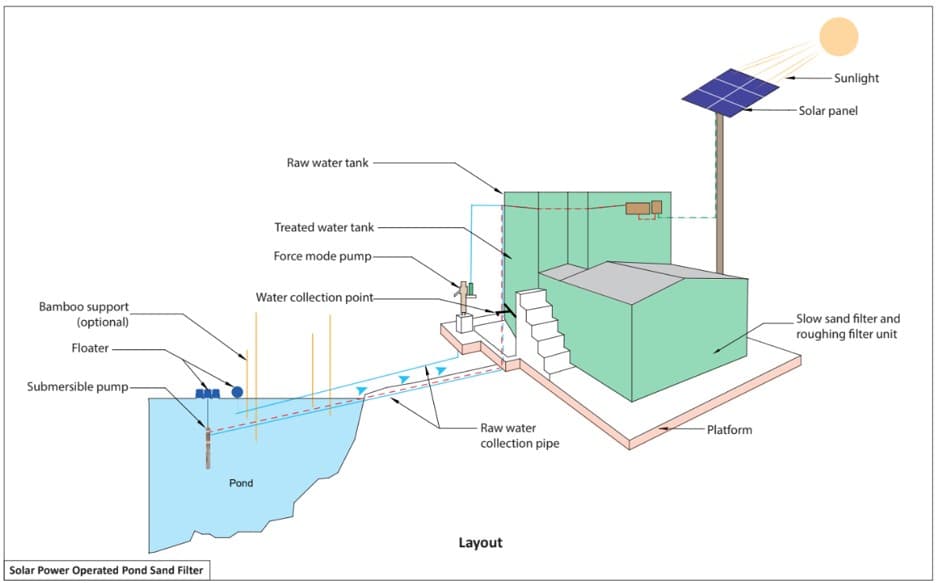
Product Overview & Mechanism
In many regions, communities rely on ponds as their primary water source, yet untreated pond water is often unsafe. AIDE's PSF systems integrate sedimentation, roughing filtration, slow sand filtration, and disinfection to produce water suitable for domestic use.
1Standard PSF
Operates using a manual pumping system (handpump). Simple, cost-effective, and suitable for smaller communities where manual operation is feasible and reliable without electricity.
- Fixed intake from pond
- Handpump / Hand-lift pump
- Intermittent, user-operated
2Solar-Powered PSF
Integrates an automated pumping system powered by solar energy. Ideal for larger communities requiring continuous supply. Reduces physical effort and ensures consistent operation.
- Floating intake for better water quality
- Solar pump + backup handpump
- Continuous and automated operation
Structured Treatment Process
Water is collected from the pond via intake system
Conveyed to a raw water tank or filtration unit
Passes through an up-flow roughing filter
Passes through a slow sand filter (removes pathogens)
Filtered water is stored and disinfected for use
Technical Drawings & Specifications
Standard Pond Sand Filter
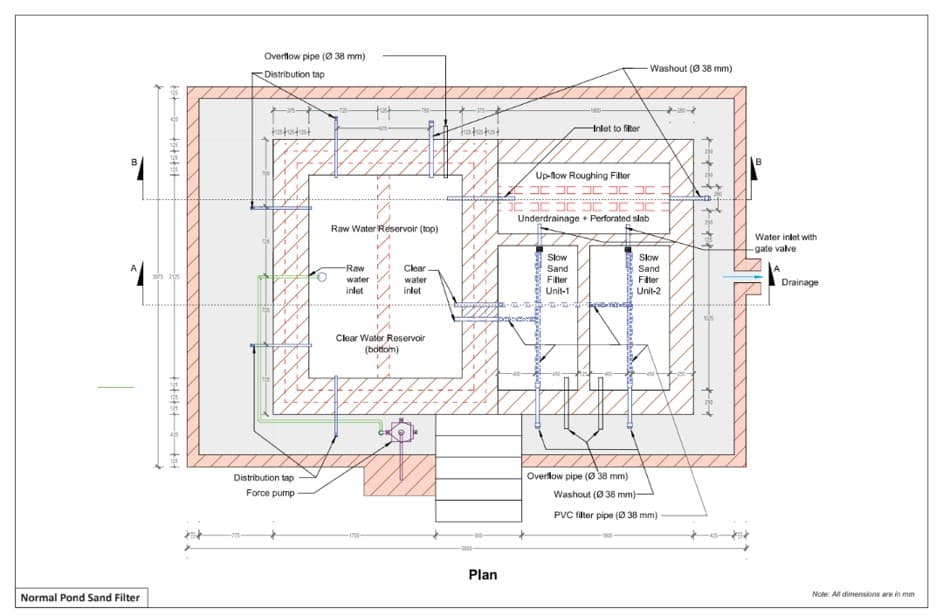
Standard PSF - Plan
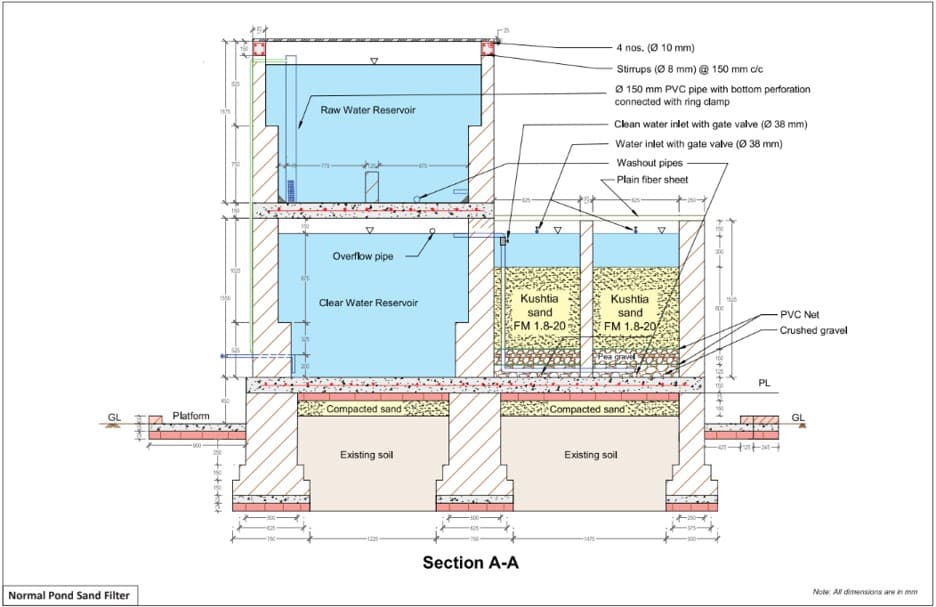
Section A-A
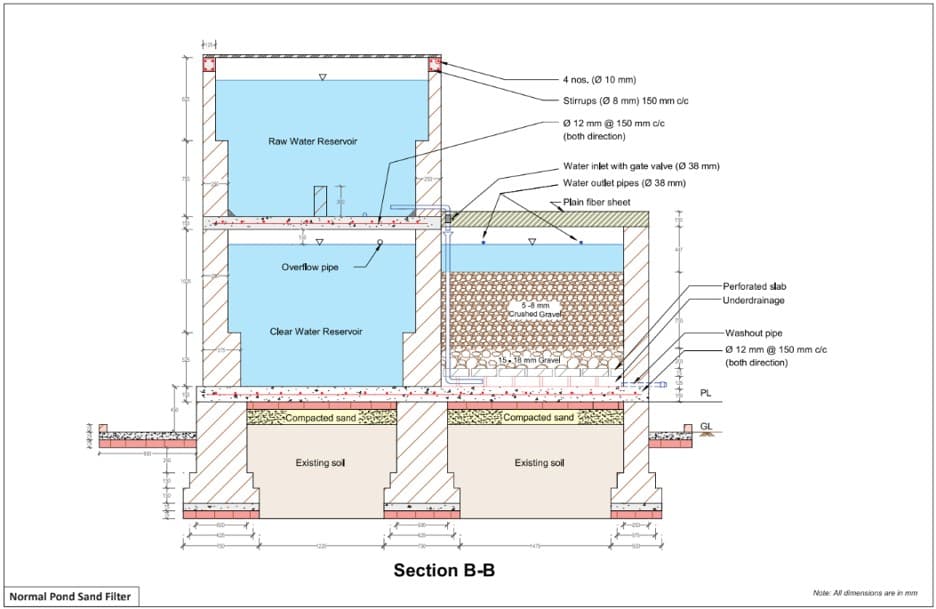
Section B-B
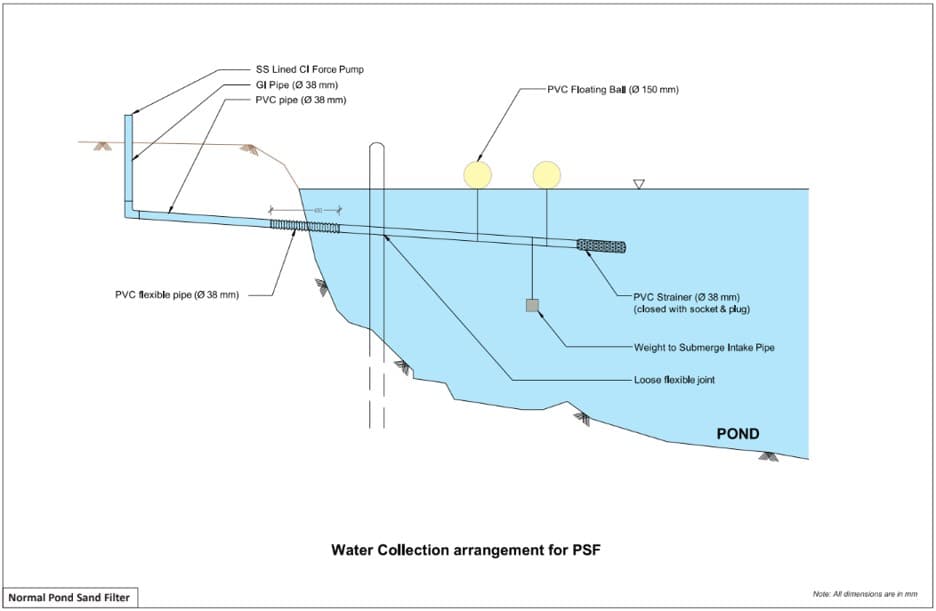
Water Collection Intake
Solar-Powered Pond Sand Filter
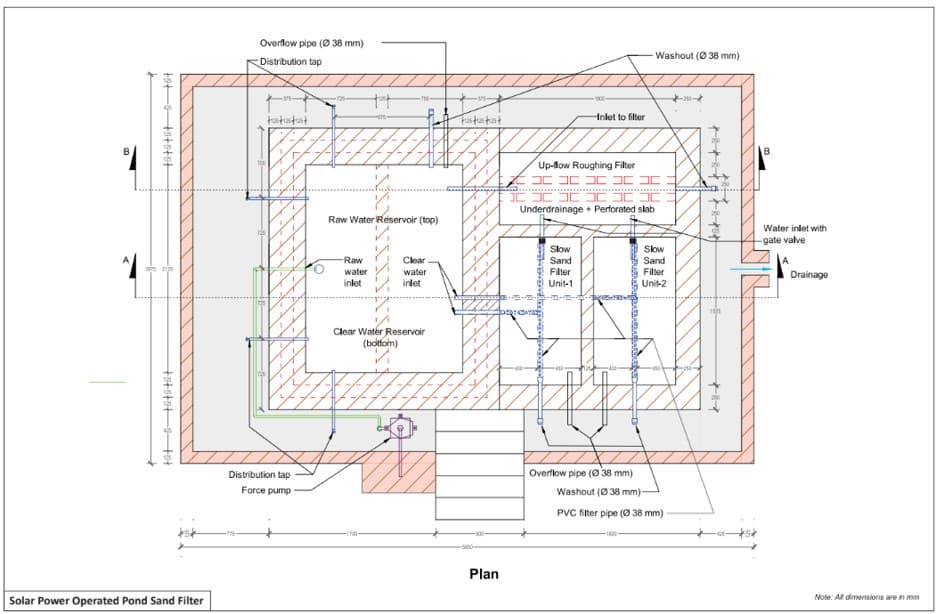
Solar PSF - Plan
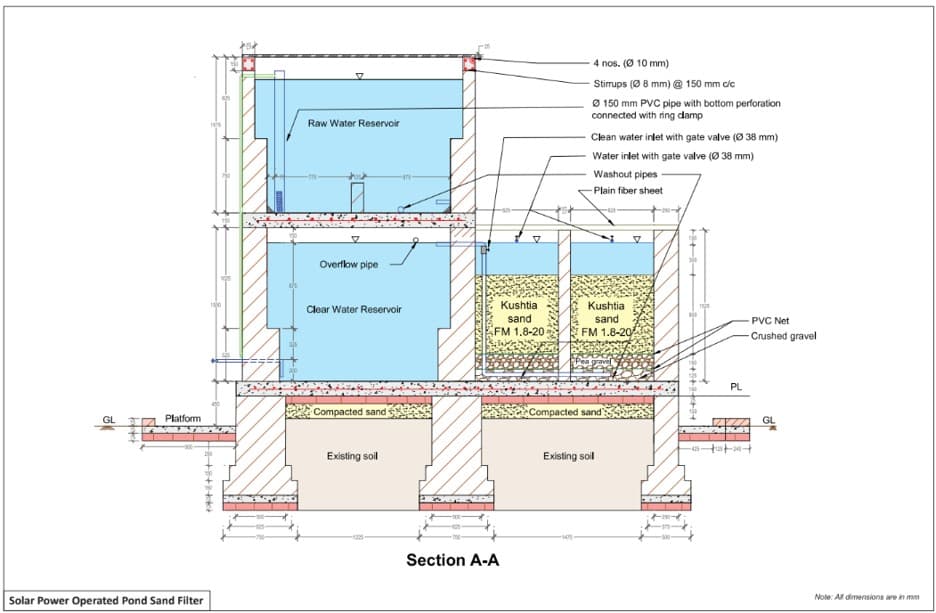
Section A-A
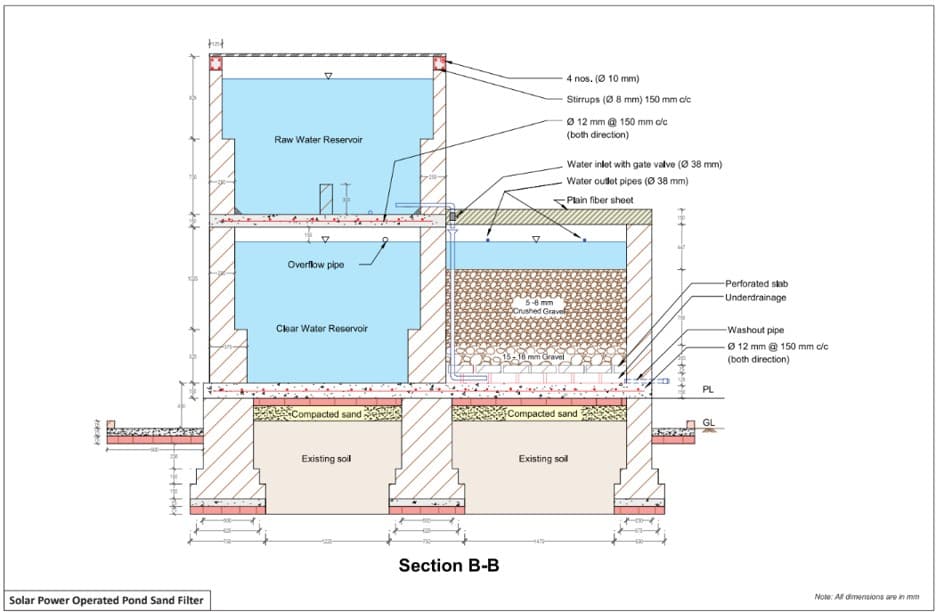
Section B-B
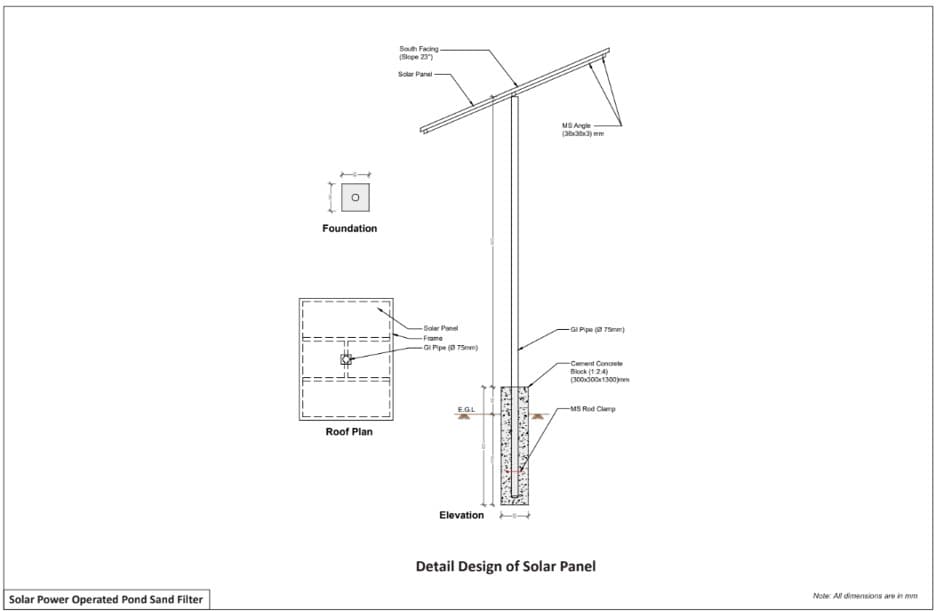
Solar Panel Framework
System Specifications
| Component | Standard PSF | Solar-Powered PSF |
|---|---|---|
| Source | Pond (low/no salinity) | Pond (low/no salinity) |
| Intake System | Fixed intake | Floating intake |
| Pumping Mechanism | Handpump / Hand-lift pump | Solar pump + backup handpump |
| Filtration System | Roughing + slow sand filter | Roughing + slow sand filter |
| Raw Water Tank | Included | Included |
| Clear Water Tank | Included | Included |
| Disinfection | Chlorination | UV / Chlorination |
| Power Source | Manual | Solar-powered |
| Operation Mode | Intermittent (user-operated) | Continuous / automated |
| Scale | Small–medium community | Medium–large community |
Key Risks to Mitigate
- Dependence on availability of low-salinity pond
- Risk of bacterial contamination without disinfection
- Need for regular system operation to maintain filter performance
- Intake clogging requires continuous monitoring
Key Features & Impact
- Provides a flexible solution adapting to small and large communities
- Standard system ensures affordability and simplicity
- Solar-powered variant enhances operational efficiency and reliability
- Removes suspended solids, turbidity, and pathogens
- Safe drinking water without relying on deep groundwater
Ideal Applications
- Coastal AreasAffected by high groundwater salinity
- Arsenic-prone RegionsWhere shallow tubewells are unsafe
- Water-Scarce LocationsDependent on surface water sources
- Small CommunitiesServed by Standard PSF
- Large PopulationsServed by Solar-Powered PSF
Implementation & Delivery
Direct or JV Model
AIDE delivers PSF systems through a structured approach. Depending on project scale, implementation may follow a direct or Joint Venture (JV) model with local partners supporting construction.
Construction Scope
- • Pond preparation and intake system installation
- • Development of filtration chambers
- • Setup of storage and distribution units
- • Integration of solar panels and controllers (if applicable)
Operation & Maintenance
Filter Bed & Disinfection
The filter bed must be regularly maintained to ensure filtration efficiency. Disinfection processes must be maintained to ensure water safety.
Pond Rehabilitation
- • Assess pond dimensions and overall condition
- • Remove floating debris and reduce turbidity using lime
- • Drain and refill if quality does not improve sufficiently
Community Role
Community members are trained on system operation, maintenance, and water safety practices during commissioning.
Why Partner with AIDE?
AIDE brings extensive experience in designing and implementing decentralized water treatment systems tailored to challenging environments. By combining technical rigor with practical field knowledge, we ensure that systems are functional and sustainable.